UL Intensity of Use#
UL use only tells us if a functional movement is being performed or not at a given instant. It contains no information about how intensely, how fast, or how strongly a functional movement is being performed. This is captured by the UL intensity of use measures[1].
The detailed module documentation for ulint can be found here.
Intensity of Use#
Definition. Instantaneous Intensity of Use is a construct that reflects how strenuous a movement/posture is at a particular instant of time when the upper limb is in use.
The magnitude of movement velocity, acceleration, interaction force, muscle activity, etc. are potential measures of instantaneous intensity of use. The instantaneous intensity of use is a non-negative signal, which is 0 when UL use is 0 (by definition).
The following code snippet shows how to compute the instantaneous intensity of use from the vector magnitude signal.
>>> import numpy as np
>>> from monalysa.ulfunc import uluse
>>> from monalysa.ulfunc import ulint
>>> fs = 100
>>> t = np.arange(0, 10, 1. / fs)
>>> vmag = np.square(np.sin(2 * t) + np.cos(0.4 * t) + 2) * np.random.rand(len(t))
>>> th1, th2l, th2h = 3, 1, 4
>>> _, u1 = uluse.from_vec_mag(vmag, thresh=th1)
>>> _, u2 = uluse.from_vec_mag_dblth(vmag, thresh_l=th2l, thresh_h=th2h)
>>> _, i1 = ulint.from_vec_mag(vmag, u1, 1)
>>> _, i2 = ulint.from_vec_mag(vmag, u2, 1)
>>> _inx1, avgi1 = ulint.average_intuse(i1, u1, windur=0.25, winshift=0.05, fs=fs)
>>> _inx2, avgi2 = ulint.average_intuse(i2, u2, windur=0.25, winshift=0.05, fs=fs)
Plotting the different intensity of use-related variables from the above code snippet, we get the following figure. UL use is detected using two approaches, and both are used to compute the instantaneous intensity of use and average intensity of use. The average intensity of use is computed over a window 0.25sec long shifting every 50ms using average_intuse.
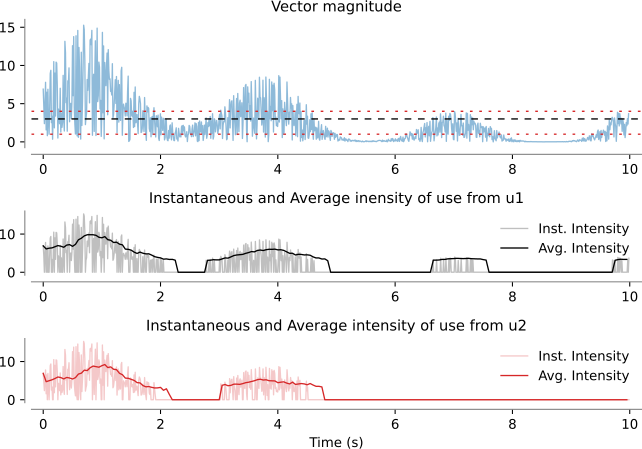
The top row displays the vector magnitude signal in light blue along with the thresholds used to detect UL use from the two functions uluse.from_vec_mag and uluse.from_vec_mag_dblth. The instantaneous and average UL intensity of use are shown in the second and third rows; the light plot is the instantaneous intensity of use, and the darker trace is the average intensity of use.
Average UL Activity#
UL use and intensity of use can be used to answer the question about how active a UL is, which includes both how long and how intensely an UL i used[1]. This is the average UL activity construct.
Definition. Average Upper Limb Activity is a construct that reflects how long and how intensely an upper limb is used in a given period \(D\).
The function average_ulactivity can be used for computing the average upper limb activity, as demonstrated by the following code snippet.
>>> import numpy as np
>>> from monalysa.ulfunc import uluse
>>> from monalysa.ulfunc import ulint
>>> from monalysa.ulfunc import measures
>>> fs = 100
>>> t = np.arange(0, 10, 1. / fs)
>>> vmag = np.square(np.sin(2 * t) + np.cos(0.4 * t) + 2) * np.random.rand(len(t))
>>> th2l, th2h = 1, 4
>>> _, _use = uluse.from_vec_mag_dblth(vmag, thresh_l=th2l, thresh_h=th2h)
>>> _, _int = ulint.from_vec_mag(vmag, _use, 1)
>>> _inxu, _avgu = uluse.average_uluse(_use, windur=0.25, winshift=0.05, fs=fs)
>>> _inxi, _avgi = ulint.average_intuse(_int, _use, windur=0.25, winshift=0.05, fs=fs)
>>> _inxa, _avga = ulint.average_ulactivity(_int, windur=0.25, winshift=0.05, fs=fs)
Plotting the different variables from the above code snippet, we get the following figure. UL use is computed using uluse.from_vec_mag_dblth and instantaneous intensity of use from uluse.from_vec_mag. The average constructs are computed over a window 0.25sec long shifting every 50ms using uluse.average_uluse and ulint.average_intuse. The average UL activity is computed using ulint.average_ulactivity.
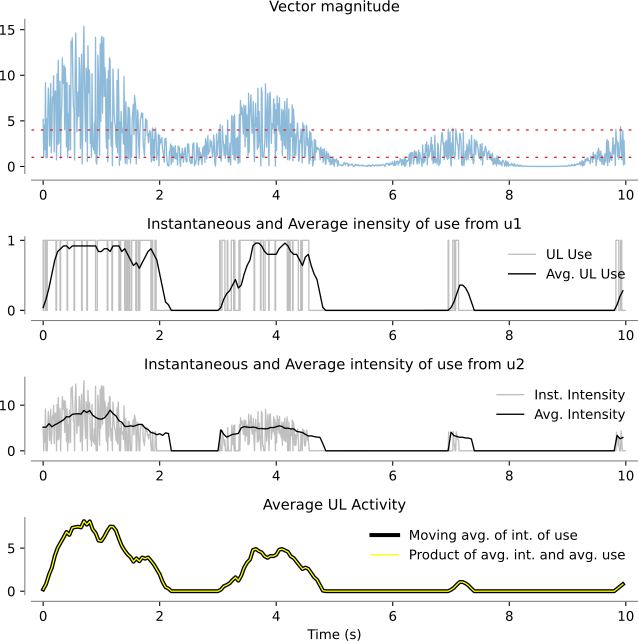
The plot in the last row displays the average UL activity computed using ulint.average_ulactivity (in black) and as the product of average UL use and average intensity of use (in yellow); both are the same.
>>> np.all(np.round((_avgu * _avgi) - _avga, 10) == 0)
True
Due to numerical precision, the two signals are not exactly the same, but they are very close up to at least 10 decimal places.
References