UL Function Measures#
UL use, intensity, and activity measures compute temporal signals related to how much a UL is used using raw measurements of movement-related variables. These signals can be used to compute an overall measure of how much a UL is used and the relative use of both ULs.
The detailed module documentation for measures can be found here.
Overall UL Activity#
The overall UL activity can be computed from the average UL activity measures[1]. This can be computed using the function measures.Hq in the measures module.
>>> import numpy as np
>>> from monalysa.ulfunc import uluse
>>> from monalysa.ulfunc import ulint
>>> from monalysa.ulfunc import measures
>>> np.random.seed(0)
>>> fs = 100
>>> t = np.arange(0, 10, 1. / fs)
>>> vmag = np.square(np.sin(2 * t) + np.cos(0.4 * t) + 2) * np.random.rand(len(t))
>>> th2l, th2h = 1, 4
>>> _, _use = uluse.from_vec_mag_dblth(vmag, thresh_l=th2l, thresh_h=th2h)
>>> _, _int = ulint.from_vec_mag(vmag, _use, 1)
>>> _inxu, _avgu = uluse.average_uluse(_use, windur=0.25, winshift=0.05, fs=fs)
>>> _inxi, _avgi = ulint.average_intuse(_int, _use, windur=0.25, winshift=0.05, fs=fs)
>>> _inxa, _avga = ulint.average_ulactivity(_int, windur=0.25, winshift=0.05, fs=fs)
>>> measures.Hq(_avga, q=90)
6.128198834355528
Relative UL Use#
Relative UL use can be computed using either UL use, intensity of use or UL activity. Three measures are supported by the measures module:
Relative UL use measures \(\mathcal{R}_{q}\) proposed by David et al.[1] can be computed using the function
measures.Rq.
Refer to David et al.[1] for more details. 2. Instantaneous laterality index computed using the asymmetry measure proposed by De Lucena et. al^[delucena2017], which can be computed at each time instant.
where \(x_r[n], x_l[n]\) is the UL use or instantaneous intensity of use of the right and left ULs at time instant \(n\), respectively. The instantaneous laterality index is computed using the function measures.instantaneous_latindex.
>>> import numpy as np
>>> from monalysa.ulfunc import uluse
>>> from monalysa.ulfunc import ulint
>>> from monalysa.ulfunc import measures
>>> np.random.seed(0)
>>> fs = 100
>>> t = np.arange(0, 12, 1. / fs)
>>> _intr = (np.sin(t) + 1) * (t > 2.0) * np.random.rand(len(t))
>>> _intr[400:500] = 0
>>> _intl = (np.sin(t - np.pi) + 1) * (t < 8.0) * np.random.rand(len(t))
>>> _intl[400:500] = 0
>>> _, _linxinst = measures.instantaneous_latindex(_intr, _intl)
>>> _inxl, _avgli = measures.average_latindex(_linxinst, windur=0.25, winshift=0.05, fs=fs)
Plotting the different variables from the above code snippet, we get the following figure. The bottom row shows the instantaneous laterality index in gray, and the average laterality index in black.
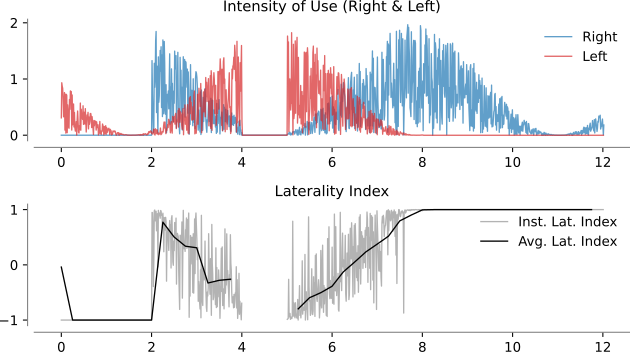
When only one of the limbs is used, the laterality index is +1 or -1; when both are not used, the laterality index is undefined.
References